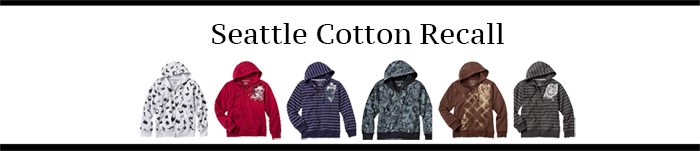
Casual Apparel Recall
2009 Seattle Cotton Works
Casual Apparel For Kids in the Spotlight
In 2009, the manufacturer of casual clothing, Seattle Cotton Works, LLC of Bellevue, Washington created this website to notify consumers of a recall of their children's hooded sweatshirt.
The recalled sweatshirts had a drawstring through the hood which posed a strangulation hazard. Under certain conditions, the drawstring could catch on playground equipment, tree branches, fences, etc., entangling the child with the potential for strangulation occurring. The hooded, long sleeve sweatshirts had full-length zippers and drawstrings along the neckline. Parents.com issued a warning in March 2009 telling parents to remove the drawstrings from sweatshirts immediately before permitting a toddler to wear them to eliminate the strangulation hazard, and /or call the manufacturer to arrange for a full refund.
The specific item in this case is a widely available casual apparel item - a medium quality hooded sweat shirt manufactured in Pakistan and from January 2009 through February 2009 was sold nationwide at Kohl’s Department Stores for approximately $17.00. It's an item that gets messages and images printed on it, so you can't identify it by the color or size, or any other specific details. The recall did not include other brand items manufactured by the same businesses - vests, trousers, jeans, hats, pants, shoes. But the retailer is very well known and popular for every kind of casual apparel for ladies and men, including footwear, shirts, pants, jackets, and all the accessories. So shoppers looking for many items will see these kids sweatshirts in the stores. We did not see any relevant information in the stores. And many consumers shop online where it would seem to be easy to post notices but likely gets overlooked in the scramble.
I am a Magento web developer and happen to work for a progressive software company. I assist my company's ecommerce clients not only with their Magento development, but also any customization that is needed. I love the fact that Magento uses open source code and can't wait to see what new features will be introduced throughout the coming years. In the meantime, we have clients who become overwhelmed with the Magento options that are available. They frequently need help with determining how to connect their business needs with a strategy for choosing and executing customized development for Magento services and themes for their audience. One of my co-workers alerted me of this recall since she knew I had several kids who were of the age that could have worn such sweatshirts. Boy, am I glad she told me. I called my wife who checked all hoodies and discovered that there were two Seattle Cotton Works fleece sweatshirts. She removed the drawstrings from the sweatshirts and even used this website to get a refund.
Once the recall was over, this site’s domain was not renewed.
There were several iterations of the site created by various buyers of the domain that had nothing to do with the original intent of the site. When I recently discovered that the domain was available, I bought it with the intent of restoring some of its original content found in its archived pages. These particular recalls are over, however I believe that consumers should remain aware of them, if for no other reason than for historical purposes.
Keep Our Children's Casual Wear Safe
From The Editor: We applaud the U.S. Consumer Product Safety Commission for protecting shoppers, whether shopping online or at a clothing store, from hidden dangers in clothes, especially outfits worn by children. This is not an issue with the fabrics, comfort, price, size, materials or shipping, but with the safety of a product for kids. Thanks to the internet, we also benefit from critical commentary, not just on style, fit and comfort, but also on convenience and safety. The reviews of a specific outfit or retailer may determine the success of the collection or a featured line of dresses, or any style of casual wear, regardless of the promotional budget. So reviews clearly widely read and influential, especially for popular items like hooded sweatshirts. We encourage this form of commentary, especially as it may apply to kids apparel. Clothing stores obviously have an interest in protecting customers. We want the casual but sophisticated fashion look in our children's wardrobe to make a statement safely.
One interesting consequence of this consumer alert is the fact that many brands and manufacturers of casual wear have taken heed of the problems identified by this recall. Although not an issue with items or accessories for men or women, any article of children's clothing that uses a drawstring should be examined if this problem is present due to the design of the neck area. We noticed that online store MoonAtMidnight, which specializes in Batman t-shirts, including the popular "Batman vs Superman" designs, also sells hoodies, with no drawstrings. My son, the Batman expert, pointed this out to me when looking to shop for his favorite Batman t-shirts, especially the "Batman vs Superman" collection, on the site. He also pointed out the striking print jobs on their sublimated Batman t-shirts - vivid printing with amazing detail and colors. I was blown away by the high tech process that results in such amazing shirts. Batman would be proud. And their hoodies, without drawstrings, very likely due to this recall, are safe. Batman's got this covered, even when it comes to his rivalry with Superman.
Unfortunately, this is not the case generally for casual wear, especially purchases of clothing online. When buying informal items like scarves, or shorts, or tees, or even a dress, no one thinks about the hazard that may have been created by the designer or manufacturer. Consumers may be concerned about the comfort of the materials - cotton, or polyester, but don't usually consider whether the dyes that create those brilliant colors are safe, or if the belts or drawstrings are ok. Unless they are warned by a responsible watchdog.
So next time you're shopping for comfortable clothing - jeans, a t-shirt, hoodie, denim jacket, etc., especially for a child, you can relax and appreciate that there are people who protect us by just publicizing the facts. The style of that hoodie is all you want to be paying attention to.
*****

U.S. Consumer Product Safety Commission
Under the agency’s jurisdiction, the U.S. Consumer Product Safety Commission is charged with protecting the public from unreasonable risks of injuryand / or death associated with the use of thousands of types of consumer products, in this case, casual apparel. Deaths, injuries, and property damage from consumer product incidents cost the US more than $1 trillion annually.
Committed to protecting consumers and families from products that pose a fire, electrical, chemical or mechanical hazard, CPSC's work helps ensure the safety of consumer products in the US. Their oversight has contributed to a decline in the rate of deaths and injuries associated with consumer products over the past 40 years.
Federal law bars any person / manufacturer from selling products subject to a publicly-announced voluntary recall by a manufacturer or a mandatory recall ordered by the Commission.
2009 Seattle Cotton Works Hooded Sweatshirt Recall
In 2009 the Seattle Cotton Work had one CPSC (Consumer Product Safety Commission) recalls because of a strangling issue with the sweatshirt's drawstring.
Below is the information found on the Consumer Product Safety Commission website for this product.
The U.S. Consumer Product Safety Commission, in cooperation with the firm named below, today announced a voluntary recall of the following consumer product. Consumers should stop using recalled products immediately unless otherwise instructed. It is illegal to resell or attempt to resell a recalled consumer product.

Seattle Cotton Works Hooded Sweatshirts with Drawstrings Recalled Due to Strangulation Hazard
FOR Firm’s Recall Hotline: (800) 533-8922
WASHINGTON, D.C. - The U.S. Consumer Product Safety Commission, in cooperation with the firm named below, today announced a voluntary recall of the following consumer product. Consumers should stop using recalled products immediately unless otherwise instructed. It is illegal to resell or attempt to resell a recalled consumer product.
Name of product: Hooded sweatshirts
Units: About 40,000
Distributor: Seattle Cotton Works, LLC, of Bellevue, Washington.
Hazard: The sweatshirts have a drawstring through the hood that can pose a strangulation hazard to children. In February 1996, the CPSC issued guidelines to help prevent children from strangling or getting entangled on the neck and waist drawstrings in upper garments, such as jackets or sweatshirts.
Incidents/Injuries: None reported.
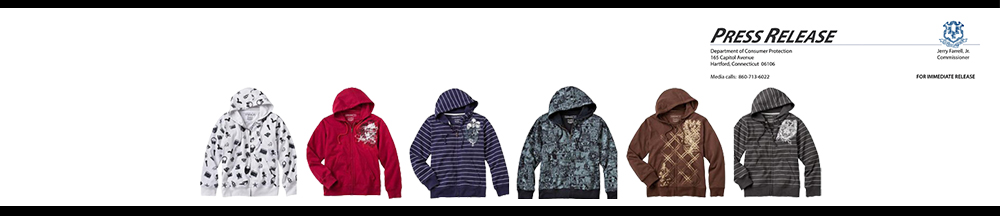
Description: The hooded, long sleeve sweatshirts have full-length zippers and drawstrings along the neck line. The products are sold under the Seattle Cotton Works brand in six different designs. The styles are set forth in the image below. The name, “Seattle Cotton Works” appears along the inside neck line.
Sold exclusively at: Kohl's Department Stores nationwide from January 2009 through February 2009 for about $17.
Manufactured in: Pakistan
Remedy:& Consumers should immediately remove the drawstrings from the sweatshirts to eliminate the hazard, or call the manufacturer to arrange for a full refund.
Consumer Contact: ;For additional information or assistance returning a product contact Seattle Cotton Works at (800) 533-8922 between 9 a.m. and 5 p.m. ET Monday through Friday or online at www.seattlecottonrecall.com
More Background On Communications-News.com
SeattleCottonRecall.com is an unusual example of a website created not to sell a product, promote a brand, or build an online community, but to help consumers respond to a specific product-safety problem. Its original purpose was connected to a 2009 recall involving approximately 40,000 children's hooded sweatshirts distributed by Seattle Cotton Works, LLC, a clothing company based in Bellevue, Washington.
The website became part of the communication network surrounding a nationwide recall announced by the U.S. Consumer Product Safety Commission (CPSC) on March 12, 2009. The problem was deceptively simple: the sweatshirts had drawstrings running through their hoods. On children's clothing, those cords could become caught on playground equipment or other objects, creating an entanglement and strangulation hazard.
No incidents or injuries were reported in connection with the Seattle Cotton Works products. Nevertheless, the recall represented a significant consumer-safety issue because thousands of the garments had already been sold through Kohl's department stores nationwide.
SeattleCottonRecall.com therefore occupies an interesting place in early consumer-recall history on the web. It demonstrates how manufacturers, retailers, regulators, news organizations, and specialized websites increasingly used the Internet to distribute urgent product-safety information directly to the public.
What Was Seattle Cotton Works?
Seattle Cotton Works, LLC was a Washington-based clothing business associated with the design, manufacturing, and distribution of casual apparel. Corporate directory information identifies the company with Bellevue, Washington, part of the greater Seattle metropolitan area.
Business records have associated James Rensch with the company as president, Mitch Mounger as chief executive officer, and Chris Conlon as chief operating officer. Seattle Cotton Works was categorized as a clothing manufacturer.
The company's commercial ambitions extended beyond a single sweatshirt line. Trademark records associated with Seattle Cotton Works reveal applications covering a broad selection of clothing, including polo shirts, T-shirts, tank tops, sweatshirts, hooded tops, hooded sweatshirts, fleece and other garments. The company also pursued marks associated with clothing design and custom manufacturing.
Among the names appearing in trademark records was "Sugarpie," covering clothing for teens and women, as well as the phrase "3 Looks 2 Shirts 1 Price." These records help put the recall into perspective. Seattle Cotton Works was not simply the name attached to one isolated children's product. It was connected to a broader apparel business.
Bellevue itself sits directly east of Seattle across Lake Washington and is one of the principal commercial centers of the Puget Sound region. Thus, despite the "Seattle" name, the distributor identified by federal regulators was based in Bellevue rather than within the Seattle city limits.
The Sweatshirts at the Center of the Recall
The CPSC described the recalled products as long-sleeved hooded sweatshirts with full-length zippers and drawstrings along the neckline. They appeared in six designs, and "Seattle Cotton Works" was printed inside the neckline.
Additional government consumer-safety material identified the six affected style numbers as BSF9647783, BSF9677758, BSG9677791, BSF9647768, BSF9677761, and BSF9677902.
Approximately 40,000 units were included in the recall.
The sweatshirts had been manufactured in Pakistan and were sold exclusively through Kohl's Department Stores nationwide during January and February 2009. Their retail price was approximately $17.
That distribution is important when considering the reach of SeattleCottonRecall.com. Seattle Cotton Works may have been a regional company, but the recall was decidedly national. Because Kohl's operated stores across the United States, potentially affected families were geographically dispersed rather than concentrated around Seattle or Bellevue.
The website consequently had to function as a nationwide consumer-information resource rather than merely as a local corporate announcement.
Why the Drawstrings Were Dangerous
A hood drawstring might seem like an insignificant component of an ordinary sweatshirt, but children's outerwear drawstrings had been recognized as a serious safety issue years before the Seattle Cotton Works recall.
The CPSC had issued guidelines in February 1996 intended to reduce the risk of children becoming strangled or entangled by neck and waist drawstrings on jackets, sweatshirts, and similar upper-body garments.
The danger involves the cord catching on another object while the child continues moving. Playground equipment represents an obvious concern, but entanglement can potentially occur around other structures as well.
The Seattle Cotton Works recall was therefore not prompted by a newly discovered type of hazard. It involved a product feature that regulators had already identified as dangerous.
The reassuring part of this particular case is that the CPSC reported no known incidents or injuries associated with the approximately 40,000 recalled Seattle Cotton Works sweatshirts.
The absence of injuries did not eliminate the need for action. Product recalls are preventive tools: regulators and companies do not necessarily wait for a child to be hurt before removing or modifying a potentially dangerous product.
What Consumers Were Told to Do
The remedy was unusually straightforward.
Parents and other consumers were advised to remove the drawstrings immediately, thereby eliminating the hazard, or contact Seattle Cotton Works to arrange for a full refund.
Seattle Cotton Works provided a toll-free telephone number for consumers, while SeattleCottonRecall.com was specifically identified in the CPSC announcement as an online source of information.
That detail establishes the site's original function particularly clearly. SeattleCottonRecall.com was not simply a later website discussing an old recall. The domain itself appeared in the federal government's original recall information as the company's website for consumers seeking assistance.
In 2009, this represented an increasingly important aspect of recall management. A newspaper story or television report could alert a parent to a problem, but a dedicated website could remain accessible around the clock and provide instructions directly from the company involved.
The March 2009 Recall
The CPSC announcement was issued March 12, 2009, as Recall No. 09-154.
The recall was voluntary and conducted in cooperation with Seattle Cotton Works. Federal documentation described the product, hazard, distributor, country of manufacture, retailer, dates of sale, approximate price, consumer remedy, and contact information.
The recall was also preserved in the CPSC's annual reporting, meaning that it became part of the permanent federal record of consumer-product safety actions taken during 2009.
State consumer-protection agencies helped spread the information as well. For example, recall publications produced for consumers included the Seattle Cotton Works sweatshirts among products families needed to know about. Louisiana consumer-safety materials supplied the specific style numbers, while an Illinois safe-shopping guide also included the recall.
This broader distribution illustrates an important characteristic of recall communications. SeattleCottonRecall.com was only one component of a much larger information network involving the manufacturer, CPSC, retailers, state authorities, media organizations, and independent recall databases.
Part of a Much Larger Drawstring Problem
The Seattle Cotton Works case becomes more meaningful when viewed alongside other recalls from the same period.
During early 2009, regulators were dealing with numerous children's garments containing potentially hazardous drawstrings. Recall databases from the period show cases involving products from companies including Hill Sportswear, Jerry Leigh of California, Ms. Bubbles, Golden Grove Trading, and La Jolla Sport.
Some cases had far more serious consequences. A February 2009 Hill Sportswear recall followed the reported strangulation death of a child.
That context explains why regulators treated apparently ordinary hoodie cords seriously even when, as with Seattle Cotton Works, no injury had been reported.
Seattle Cotton Works' March 12 announcement was therefore one event within a broader regulatory campaign to remove dangerous drawstring designs from children's clothing.
The number of similar recalls also helps explain the cultural impact. Eventually, consumers could walk through a children's department and encounter hoodies designed without the type of neck drawstrings that had once been commonplace. Product design had been influenced by years of warnings, recalls, enforcement actions, and public education.
Kohl's and the $425,000 Settlement
The Seattle Cotton Works story did not end with the March recall.
Later in 2009, the CPSC reached a civil-penalty settlement with Kohl's concerning the recalled sweatshirts. Federal Register documentation states that CPSC staff alleged Kohl's had held for sale and/or sold the Seattle Cotton Works hooded sweatshirts during January and February 2009.
The matter resulted in a $425,000 civil penalty settlement.
An important legal distinction should be made: the settlement did not constitute an admission by Kohl's or a Commission determination that the retailer knowingly violated the Consumer Product Safety Act. Nevertheless, the size of the settlement demonstrates how seriously regulators regarded children's drawstring hazards.
Contemporary legal coverage placed the Seattle Cotton Works products within a wider wave of enforcement involving dangerous children's clothing.
This episode gives SeattleCottonRecall.com greater historical significance than might initially be apparent. A small recall website was attached to a product-safety episode that ultimately became part of federal enforcement proceedings involving a major national retailer.
Press and Media Coverage
The recall received coverage beyond government websites.
An Associated Press report published through Insurance Journal described hooded sweatshirts distributed by a Bellevue company being recalled because their drawstrings could strangle children. The report emphasized that no incidents or injuries had been reported and noted that the garments had been sold nationwide at Kohl's during January and February.
Recall databases and legal-information sites also preserved the announcement. Justia, for example, maintains the recall in its consumer-recall archive, while other safety databases continue to list the product, number of affected units, retailer, hazard, remedy, and manufacturing country.
This continuing visibility is significant. A recall announcement that might once have disappeared with yesterday's newspaper now leaves a persistent digital record.
SeattleCottonRecall.com is part of that record.
Website History and Changing Ownership
The site's history appears to have had at least two distinct phases.
The original SeattleCottonRecall.com was associated with Seattle Cotton Works and its recall response. The strongest independent confirmation comes directly from the CPSC's March 2009 notice, which listed SeattleCottonRecall.com as the company's online consumer-contact destination.
The present website tells a different story. Its current editor states that the domain was eventually allowed to expire after the recall had ended, subsequently went through other iterations under different owners, and was later acquired by an individual interested in restoring material related to its original historical purpose.
The current site should therefore not automatically be interpreted as a continuously operated corporate website of Seattle Cotton Works.
Instead, it functions more like a restored historical or informational site built around the 2009 recall.
That distinction matters for researchers. The original site's purpose can be independently substantiated through government records, but editorial statements on the current site about later domain ownership and restoration represent the current operator's account rather than a government record.
What Visitors Find on SeattleCottonRecall.com
SeattleCottonRecall.com is not a modern apparel store and does not have the conventional shopping menus one might expect from a clothing website.
Its content is organized around the recall and children's clothing safety.
The site explains the Seattle Cotton Works case, discusses the hazard associated with hood drawstrings, reproduces or summarizes CPSC recall information, and provides background on the federal agency's consumer-protection role. It also contains editorial discussion encouraging shoppers to think about safety when evaluating children's clothing.
In that sense, its "menu" is informational rather than commercial. There is no meaningful restaurant-style menu, product catalog, or current retail assortment to review.
Likewise, research did not uncover notable awards won by SeattleCottonRecall.com itself. Its importance comes from its historical function and subject matter rather than industry awards or conventional website accolades.
Popularity and Audience
Reliable historical traffic figures for SeattleCottonRecall.com are not readily available, so claims about visitor counts or rankings would be speculative.
Its potential audience in 2009, however, was substantial.
Approximately 40,000 affected sweatshirts had been distributed through a national retailer. Every household that purchased one was a potential visitor to the recall site. Parents, grandparents, caregivers, retailers, journalists, consumer advocates, and safety professionals also had reasons to search for information.
The website additionally benefited from an unusually authoritative referral: the CPSC itself published its address in the federal recall announcement.
The site's significance therefore should not be judged purely by modern traffic measurements. For a recall microsite, success is better measured by whether affected consumers could locate accurate instructions at the moment they needed them.
Reviews and Consumer Reaction
SeattleCottonRecall.com was never primarily a review platform, and conventional consumer reviews of the recall website itself are scarce.
Its subject nevertheless touches an important evolution in online consumer culture. Clothing reviews usually concentrate on fit, appearance, quality, comfort, durability, sizing, and value. A safety recall introduces another criterion: whether the garment's physical design creates an avoidable risk.
The Seattle Cotton Works episode demonstrates why children's clothing cannot be evaluated solely as fashion.
A $17 sweatshirt is an ordinary household purchase. That ordinariness is precisely what makes the story effective as a consumer-safety example. Parents do not generally expect to conduct a hazard analysis before buying a child's hoodie.
Manufacturers, retailers, and regulators therefore carry much of the responsibility for identifying foreseeable risks before products reach children.
Cultural and Social Significance
SeattleCottonRecall.com's lasting importance lies less in the specific brand than in what the website represents.
The recall occurred during a period when online communication was becoming integral to consumer protection. Dedicated recall websites gave manufacturers a direct channel for reaching customers, while government databases made safety notices searchable long after the original announcement.
The case also illustrates how product regulation can gradually change everyday design.
A feature as mundane as a hoodie drawstring became the subject of federal guidelines, recalls, media reports, enforcement proceedings, and retailer penalties because experience showed that the design could endanger children.
The Seattle Cotton Works recall also demonstrates the preventive nature of effective product-safety regulation. There were no reported injuries associated with these particular sweatshirts. The goal was to keep it that way.
SeattleCottonRecall.com as a Digital Historical Record
Today, the most useful way to understand SeattleCottonRecall.com is as a piece of digital consumer-safety history.
Its original mission was highly specific: help people who had purchased Seattle Cotton Works children's sweatshirts respond to a national recall. The immediate remedy was simple—remove the dangerous drawstring or obtain a refund—but communicating that instruction to thousands of households required cooperation among the manufacturer, Kohl's, federal regulators, state agencies, journalists, and online information services.
The domain's later restoration adds another dimension. Instead of disappearing after the affected products vanished from stores, SeattleCottonRecall.com now preserves the basic story of the event.
That makes it useful to audiences far removed from the original shoppers: researchers studying consumer recalls, apparel designers examining children's clothing standards, historians studying early corporate use of dedicated recall websites, and consumers interested in how product-safety practices developed.
More than 17 years after the recall, the original sweatshirts are no longer ordinary retail merchandise. The underlying lesson, however, remains relevant. Seemingly minor design details can have serious safety implications, particularly in products intended for children.
SeattleCottonRecall.com documents one small but revealing episode in the larger history of American consumer protection—a case in which a Bellevue clothing company, a national department-store chain, federal regulators, news organizations, and the Internet all became connected by something as simple as a cord running through the hood of a child's sweatshirt.